> ## Documentation Index
> Fetch the complete documentation index at: https://quivr-fix-docs.mintlify.site/llms.txt
> Use this file to discover all available pages before exploring further.
# Technical Design
> Learn how Quivr works under the hood
## Backend Stack
### FastAPI: The Foundation of Quivr
FastAPI is central to Quivr's high-performance capabilities. Here, we explore its role and the benefits it brings to the table.
FastAPI is a leading-edge web framework for building APIs with Python 3.6+.
It stands out for its speed, efficiency, and compatibility with modern
development needs. - **Speed**: FastAPI is one of the fastest web frameworks
for Python... - **Type Checking**: Utilizes Python type hints for
validation... - **Asynchronous Coding**: Supports asynchronous request
handling...
Our selection of FastAPI aligns perfectly with Quivr's design philosophy...
* **Performance and Scalability**: FastAPI's speed makes Quivr highly
efficient... - **Ease of Use**: Its intuitive design allows for rapid
development... - **Rich Feature Set**: FastAPI comes with built-in support
for data validation...
FastAPI's performance metrics are superior when compared to counterparts
like Flask and Django... - **Flask**: While Flask is simpler, FastAPI
provides built-in support... - **Django**: Django is a full-stack framework,
but for API development...
### Authentication: Secure Access to Quivr
Secure and streamlined authentication is key to accessing Quivr's features.
Sign up for Quivr and navigate to the `/user` page on your user dashboard.
Generate your unique API key in the settings, your access token to Quivr's
backend services.
Include the generated API key in the request header for secure access.
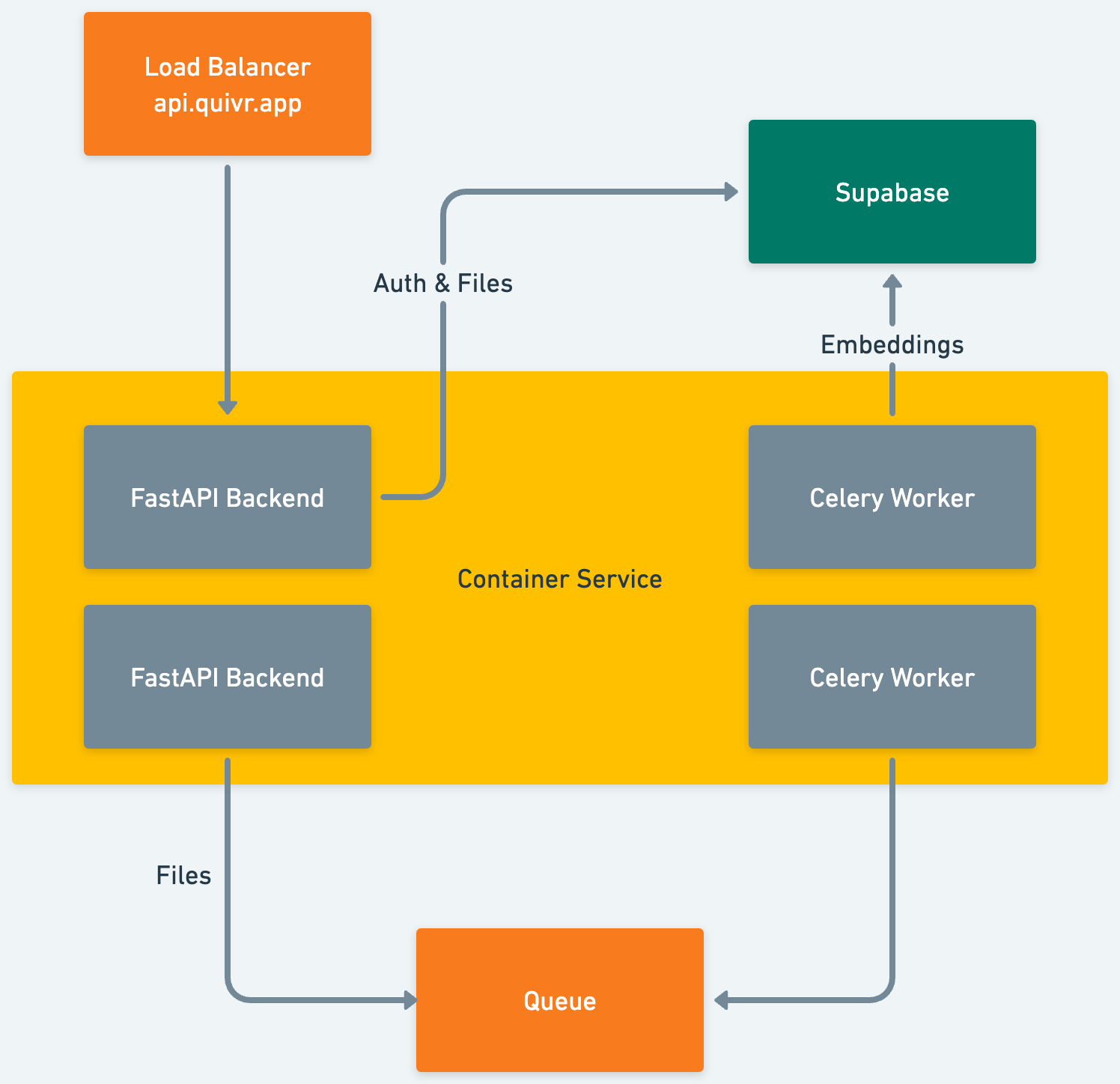
### The Architecture of Our Kingdom: Robust and Scalable
Quivr's architecture is a testament to modern, scalable web service design:
The Load Balancer efficiently manages incoming traffic, ensuring optimal
performance.
Our Container Service orchestrates digital services, maintaining operational
harmony.
The Queue system prioritizes and manages task execution.
Celery Worker handles queued tasks, ensuring timely and effective execution.
### Words of Wisdom: Keeping Your API Secure
Always protect your API key. It's crucial for maintaining the security and
integrity of your access to Quivr.
### The Balance of Power: Pros and Cons Analysis
Understanding the pros and cons of FastAPI helps in making informed decisions:
FastAPI enhances development with its swift performance...
While advantageous, FastAPI requires understanding of modern programming
concepts...
### Interactive API Sandbox: Experience Quivr in Action
Engage with Quivr's functionality in real-time in our interactive API sandbox:
🌐 [Test and refine your API calls using our
sandbox.](https://api.quivr.app/docs)
## Frontend
### Next.js and Vercel: The Dynamic Duo
Quivr's frontend is crafted with Next.js, a cutting-edge React framework, and is hosted on Vercel, a platform tailored for frontend frameworks like Next.js. This combination provides a seamless, efficient, and scalable user experience.
### Next.js: The Power of React Enhanced
Next.js is chosen for its robust features that elevate the React development experience:
Next.js supports SSR and Static Generation, crucial for performance and SEO.
This ensures Quivr's pages are pre-rendered for faster load times and
improved search engine visibility.
Next.js allows the creation of API endpoints within the application,
enabling a seamless blend of client and server-side logic.
With features like fast refresh and built-in CSS support, Next.js
streamlines the development process, boosting developer productivity.
Next.js's architecture facilitates easy scaling of applications to meet
growing user bases and complex features.
### Vercel: Optimized Hosting for Next.js
Vercel, renowned for its global deployment capabilities and serverless functions, hosts Quivr's frontend:
Vercel, built by the creators of Next.js, ensures seamless integration and
optimal performance for Quivr's frontend.
Leveraging Vercel's Edge Network reduces latency and speeds up content
delivery, enhancing user experience.
Continuous deployment on Vercel allows for swift and efficient updates,
keeping Quivr's frontend up-to-date.
Vercel's infrastructure automatically scales to meet user demand, ensuring
consistent performance even during peak times.
By combining Next.js and Vercel, Quivr achieves a robust, scalable, and
responsive web application, meeting the demands of modern web users and
developers.
This integration of Next.js and Vercel is a testament to Quivr's commitment to delivering
high-quality, responsive, and dynamic web applications, catering to modern web development
needs.
## Architectural Overview
Explore the intricacies of Quivr's architecture through this detailed diagram:
 ## Quivr Community
Your input is invaluable in shaping the future of Quivr. Connect with us:
Share your feedback and suggestions to enhance Quivr.
Engage with peers in our forums and social platforms for support and
collaboration.
***
## Quivr Community
Your input is invaluable in shaping the future of Quivr. Connect with us:
Share your feedback and suggestions to enhance Quivr.
Engage with peers in our forums and social platforms for support and
collaboration.
***